
Refillable perfume has moved from a novelty to a routine option, and the cost conversation has moved with it. Three things genuinely changed: the availability of refill mechanisms, the regulatory pressure on packaging, and the willingness of buyers to plan for repeat fills. What did not change is the arithmetic of tooling, the extra validation a refill needs, and the fact that a first order always costs more per unit than a second one.
Key takeaways
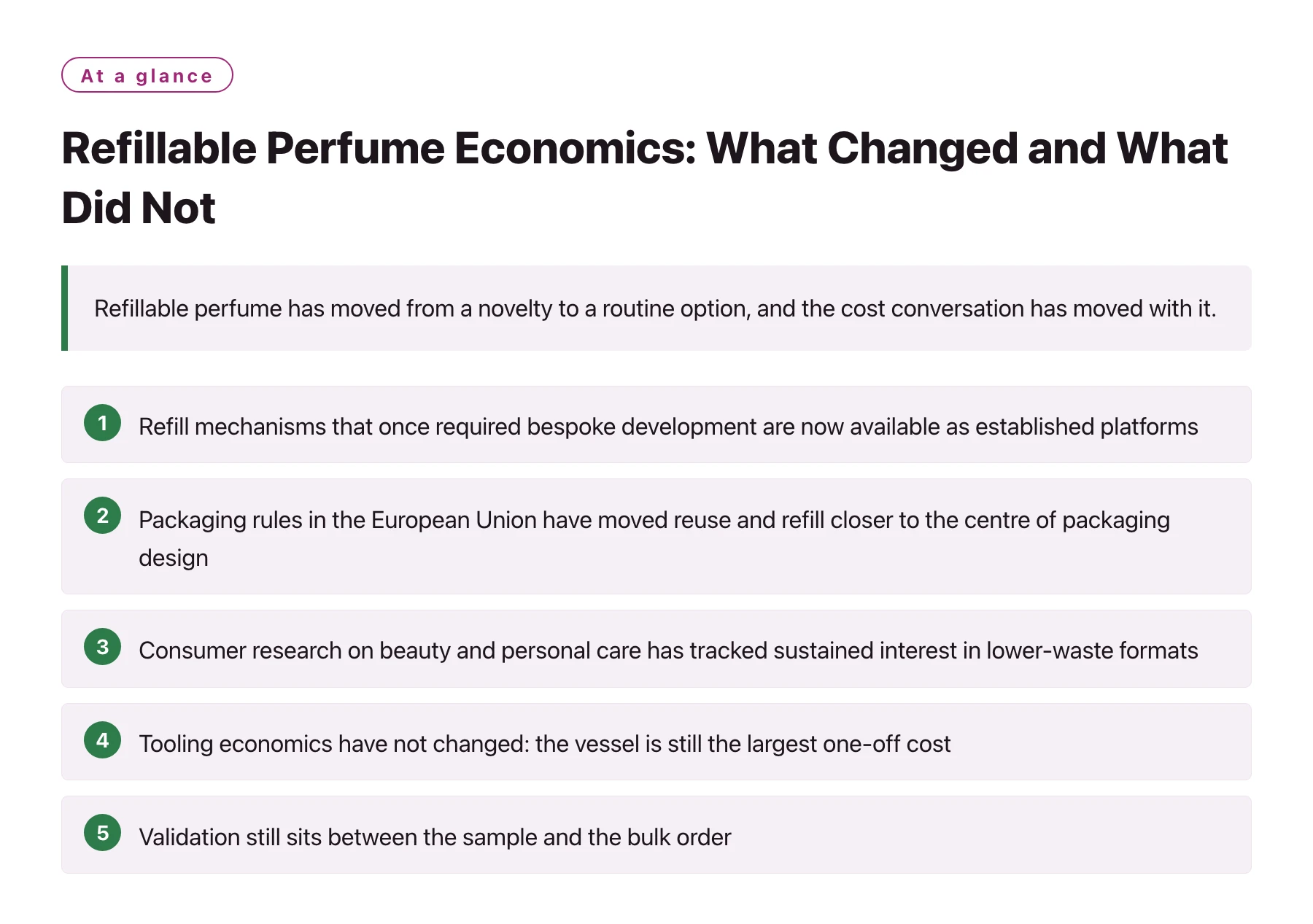
- Refill mechanisms that once required bespoke development are now available as established platforms, which lowers the entry cost of a refillable range.
- Packaging rules in the European Union have moved reuse and refill closer to the centre of packaging design, which affects artwork and reporting as well as materials [1].
- Consumer research on beauty and personal care has tracked sustained interest in lower-waste formats, which makes the refill proposition easier to sell internally [2].
- Tooling economics have not changed: the vessel is still the largest one-off cost, and the refill mechanism still decides the filling line.
- Validation still sits between the sample and the bulk order, and it is still the step buyers try hardest to skip.
Anyone who costed a refillable perfume several years ago would find the conversation familiar but the options different. The structural questions are the same, the answers have more precedent, and the regulatory backdrop has become a factor rather than a footnote.
This is written for a buyer who needs to know which parts of an old cost model to keep and which to update. It is not a forecast. It separates changes that are visible in quotations today from arithmetic that behaves exactly as it did before.
The distinction matters because refillable formats are often justified with a general argument about sustainability, when the decision actually rests on a much narrower set of numbers.
Three shifts that moved refillable formats forward
Each of the three shifts below is visible in how refillable programmes are briefed today, and each has a different effect on the cost sheet.
Mechanisms became platforms rather than projects
A refill interface used to be a development project in its own right. Today several established mechanisms can be bought as platforms, which removes a development cycle and a large part of the tooling risk from the first order.
The trade-off is differentiation. A platform mechanism is shared with other brands, so the vessel and the decoration have to carry more of the identity.
Packaging rules started to treat refills as packages
Regulation has moved reuse and refill closer to the centre of packaging design in the European Union, which means the refill is increasingly treated as a package with its own obligations rather than as an accessory [1].
For a buyer this shows up as extra artwork, extra data and occasionally a different material choice. It rarely changes the fill cost, but it does change the effort around it.
Broad regulatory movement in beauty markets is followed closely by the trade press for a reason: an obligation that starts in one market tends to appear elsewhere later [3].
The commercial argument became easier to make
Consumer research in beauty and personal care has continued to show interest in formats that reduce waste, which makes a refill line easier to justify to a retailer or an internal finance team [2].
That is a demand-side change, not a cost-side one. It affects how quickly a refill range can be listed, not what it costs to make.
What changed, and what it does to the numbers
| What changed | Effect on unit cost | What to do differently |
|---|---|---|
| Refill mechanisms sold as platforms | Lower development and tooling cost on the first order | Spend the saving on vessel identity and decoration |
| Reuse and refill written into packaging rules | Little change to fill cost, more work around data and artwork | Budget compliance effort as its own line |
| Retail interest in lower-waste formats | No direct cost effect | Use it to justify a longer programme rather than a cheaper unit |
| More suppliers offering sealed refills | Quotes easier to compare, assumptions easier to miss | Force every quote onto cost per delivered fill |
| Faster prototyping tools | Fewer sample rounds, but no change to validation | Keep the validation budget separate from sampling |
Only one row in this table reduces the first-order cost, and it is the one buyers are least likely to ask about.
What has not changed, and still decides the numbers
Two pieces of arithmetic survive every format trend, and a programme that ignores either will be surprised twice.
The first order is still the expensive one
Tooling, first-article approval and the initial validation do not repeat. The second order therefore looks dramatically cheaper per unit, and treating the first-run price as the steady-state cost makes a viable product look unviable.
The same logic applies to the pack as to the fragrance. A quality programme that measures how the closure behaves over repeated use does more for a refillable range than any change of decorator, which is the practical side of premium fragrance OEM and QA work.
Experience is a reasonable filter when comparing suppliers, since a house that has run refill formats before tends to know which checks belong on the first order. a Chinese fragrance manufacturer since 1994 is one public example of a long production history, and the point of looking is to see whether the format has been handled before.
The refill is still a separate release
Whether the mechanism is bespoke or bought as a platform, the filled refill has to be released as its own unit, with its own record and its own checks. That requirement has not softened with familiarity; if anything, buyers now ask for the evidence earlier.
The work also sits with a named manufacturer rather than with an abstract supply chain. Xuelei fragrance house is an example of a producer that publishes its scope and certifications, which is the minimum a buyer needs to know before deciding which party holds which release.
A useful way to test whether a cost model has actually been updated: ask which line item the refill mechanism appears under. If the answer is packaging, the model is still describing the format the way it was costed a decade ago.
Sources
- European Commission: Packaging Waste and the PPWR —— EU rules on packaging and packaging waste, including the Packaging and Packaging Waste Regulation requirements on recyclability and design.
- Mintel Press Centre —— Mintel's press releases on consumer and beauty market research, including fragrance and personal care trend reporting.
- Cosmetics Business —— A trade publication covering the beauty and cosmetics industry, including fragrance launches and regulatory developments.
Frequently asked questions
Has a refillable format become cheaper to launch?
The entry cost has fallen where a platform mechanism can be used instead of a bespoke one, because development and tooling shrink. A fully bespoke mechanism and vessel still carries the same one-off costs as before.
Do packaging rules change the unit cost of a refill?
Usually not the fill itself, but they do change what surrounds it: material choices, information the pack must carry, and the effort needed to evidence recyclability or reuse. That effort belongs in the budget as a separate line.
Why do buyers still skip validation on refillable formats?
Because a refill looks like an ordinary bottle with an extra part, so validation seems redundant. The repeated opening and closing is what makes it necessary, and it is the failure mode customers notice most quickly.
Is the second production order really much cheaper?
Yes, when the first order carried development, tooling and initial validation. Comparing the first and second quotations on the same specification is one of the clearest ways to understand which costs were genuinely one-off.
Should a brand choose a platform mechanism or develop its own?
A platform lowers the cost and the risk of the first order, at the price of a shared interface. A bespoke mechanism buys distinctiveness and control, and is usually justified once the brand knows the format sells.